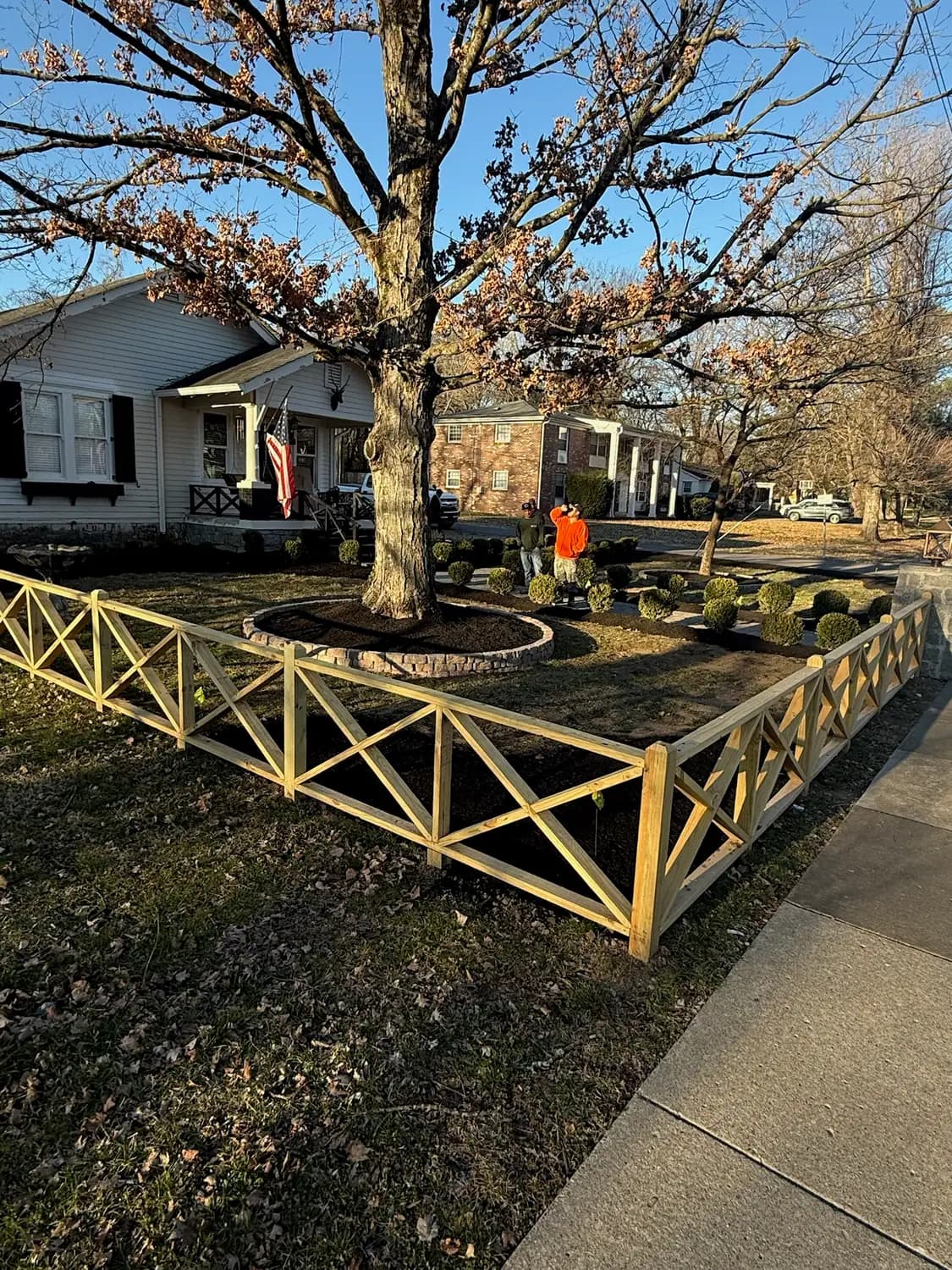
A tree in decline gives you months or years of warning, and the symptoms are frustratingly generic. Thinning canopy, smaller leaves than last year, yellowing, dieback starting at the top, early fall color on one side. Almost every cause produces some combination of those.
What narrows it down is looking at the base of the trunk first, not the leaves. Three of the five most common causes in North Texas are visible at ground level, and all three were set in motion on planting day.
Start at the base and look for the flare
Where the trunk meets the ground, it should widen out into the buttress roots, like the base of a wine glass. That widening is the root flare.
If your trunk goes into the soil like a telephone pole, straight down with no widening, the flare is buried. This is the most common cause of slow tree death in DFW landscapes and almost nobody recognizes it.
A buried flare keeps bark that evolved to be dry constantly moist. It rots, and roots circle around the trunk and slowly girdle it. The tree declines over five to fifteen years, which is long enough that nobody connects it to the planting.
Excavating the flare carefully back to grade can save a tree caught early. Piled mulch against the trunk, the mulch volcano, causes the same problem and is much easier to fix.
| What you see | Likely cause | Where to check |
|---|---|---|
| Trunk enters soil like a pole | Buried root flare | Base of trunk |
| Trunk flattened on one side | Girdling root | Base of trunk |
| Yellow leaves, green veins | Iron chlorosis | Leaf, and species choice |
| Rapid thinning in an oak | Possible oak wilt | Call an arborist |
| Decline 2 to 4 years post-build | Construction damage | Root zone history |
Check for girdling roots
While you are at the base, look for a root crossing over or wrapping around the trunk.
These usually start in the nursery container, where roots hit the wall and circle. Planted without being cut or teased apart, they keep circling and eventually strangle the trunk as both thicken.
The tell is a trunk that looks flattened or indented on one side rather than round, often with dieback in the canopy directly above that side. An arborist can sometimes sever a girdling root, though it is a judgment call once the root is large.
Yellow leaves with green veins means chlorosis
If the leaves are yellow but the veins stay distinctly green, that is iron chlorosis, and it is a soil chemistry problem rather than a disease.
North Texas soil is alkaline. Species adapted to acidic soil cannot take up iron at that pH, no matter how much iron is present. Silver maple, pin oak, sweetgum, and river birch are all sold in DFW garden centers and all commonly chlorotic here.
Chelated iron treatments help temporarily and have to be repeated. There is no permanent fix, because the soil is not going to change. The honest answer for a badly chlorotic tree is usually replacement with a species suited to the site.
Sudden decline in oaks needs urgency
If you have a red oak or live oak that went from healthy to badly thinning within a single season, treat that as potential oak wilt and get a certified arborist out quickly.
Oak wilt is a fungal disease that moves between trees through connected root systems and by beetles carrying spores to fresh wounds. It kills red oaks fast, often within months.
This is one of the few tree problems where speed genuinely matters, because the response involves trenching to sever root connections to neighboring oaks, and that only helps if it happens before the fungus has already moved.
The practical prevention is simple: do not prune oaks between February and June, and paint any wound on an oak immediately regardless of season.
Construction damage shows up years late
If anything was built, trenched, or driven over within the root zone in the last few years, that is a strong candidate.
A tree's feeder roots are mostly in the top foot of soil and extend out to roughly the drip line and beyond. Trenching for a pool, irrigation, or a foundation cuts a large share of them. Heavy equipment parked over the root zone compacts soil so severely that roots suffocate.
The decline typically appears two to four years after the work, long enough that the connection gets missed. There is no reversing it, though decompaction and careful watering can help a tree stabilize at a reduced canopy.
When to call an arborist rather than us
We plant trees, prune them, and clear storm debris. We are not certified arborists, we do not climb, and we do not diagnose or treat tree disease.
Call a certified arborist for suspected oak wilt, any large tree in decline, structural concerns like cracks or leaning, girdling root surgery, or anything involving climbing or removal. The certification exists for good reason and a misdiagnosed oak can take the neighbors' trees with it.
Where we help is the part that overlaps with the landscape: exposing a buried flare, correcting a mulch volcano, fixing the drainage that is drowning the root zone, and planting the right species next time.
Key takeaways
- Look at the trunk base before the leaves. A buried root flare is the most common slow killer in DFW.
- Yellow leaves with green veins is iron chlorosis, a soil pH problem, and usually means the wrong species for alkaline soil.
- Sudden thinning in a red oak or live oak warrants an urgent call to a certified arborist.
- Never prune oaks February through June, and seal any oak wound immediately year-round.
- Construction inside the root zone shows up as decline two to four years later.
Sources
Considering tree & shrub planting for your yard?
Species selection, correct planting depth, and establishment that actually takes.
Explore our Tree & Shrub Planting serviceLandscaping near you
We design and build across Dallas-Fort Worth. Explore our work in these communities:
The Dallas Dream Yard Team
Landscape & Outdoor Living
Serving McKinney, Frisco, Plano, Allen, Prosper & the greater DFW area